Are World Models the Next Frontier After LLMs?
In the wake of recent advances, Large Language Models have redefined what machines can do with text. They summarize, reason, translate, generate code, and assist in research workflows. But as impressive as LLMs are, an important question is emerging:
Is next-token prediction enough to build systems that truly understand and interact with the world?
A growing body of research suggests that the next frontier may lie in World Models; systems that attempt to model how environments evolve over time, not just how language continues.
Let's explore what that means and why it matters.
1. What Is a World Model?
In simple terms, a world model is a system that learns:
- The structure of an environment
- The dynamics of how that environment changes
- The consequences of actions within it
This idea has strong roots in reinforcement learning research. Notably, work by David Ha and Jürgen Schmidhuber explored compact neural networks that could learn latent representations of environments and simulate future states.
Unlike LLMs, which predict the next token in a sequence, world models aim to predict:
The next state of the environment given the current state and action.
That is a fundamentally different objective.
2. LLMs vs World Models: A Conceptual Shift
At a high level, the difference looks like this:
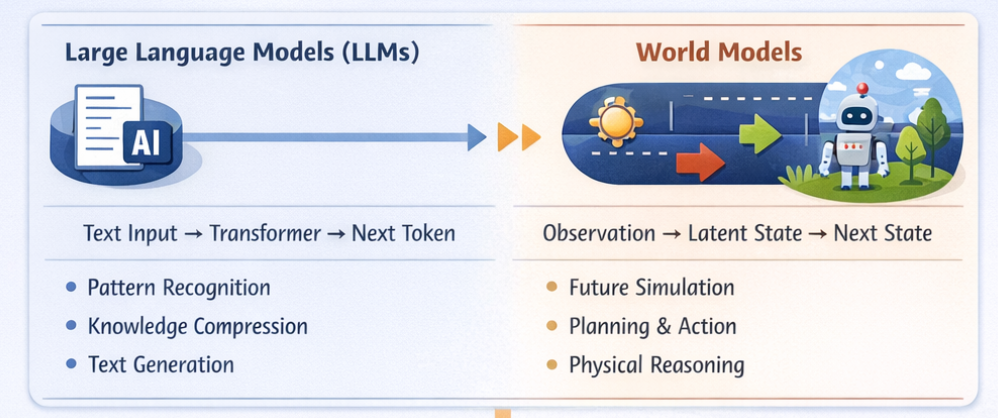
LLM (Text-Centric)
Pipeline:
Text Input → Transformer → Next Token → RepeatStrengths:
- Rich pattern recognition
- Massive compression of textual knowledge
- Strong generalization across language tasks
Limitations:
- No explicit grounded model of physical or causal reality
- Planning ability limited to textual simulation
World Model (State-Centric)
Typical pipeline:
Observation → Encoder → Latent State

Latent State + Action → Dynamics Model → Next Latent State
Next Latent State → Reward / Value Estimator

Planner:
    Simulate multiple action sequences
    Accumulate predicted returns
    Select optimal action
Strengths:
- Simulates possible futures
- Enables multi-step planning
- Supports decision-making under uncertainty
Limitations:
- Harder to train at scale
- Requires structured interaction data
- Often constrained to specific domains (e.g., games, robotics)
3. Why This Matters Now
As of today, LLMs dominate AI infrastructure discussions. However, several limitations are becoming clearer:
- Hallucination in factual reasoning
- Limited grounding in physical reality
- Weak long-term planning beyond textual simulation
At the same time, embodied AI systems and robotics research continue exploring learned dynamics models. Research groups such as DeepMind have invested significantly in model-based reinforcement learning approaches. Earlier work at OpenAI also explored model-based planning agents and simulated environments.
The convergence is becoming visible:
What if LLMs become components inside larger world models?
Instead of only generating text, future systems might:
- Maintain persistent internal world states
- Simulate multi-step outcomes before responding
- Ground language in perception and action
4. From Prediction to Simulation
LLMs excel at pattern continuation. World models aim at simulation.
That shift changes the capability stack:
| Capability | LLMs | World Models |
|---|---|---|
| Text generation | Primary strength | Not primary focus |
| Multi-step planning | Prompt-based / heuristic | Architecture-level / explicit |
| Environment dynamics modeling | Implicit statistical learning | Explicit learned transition model |
| Long-horizon decision optimization | Weak / indirect | Core objective |
World models enable something critical:
Counterfactual reasoning.
"If I take action A, what happens five steps later?"
LLMs can approximate this in text. World models attempt to simulate it within a learned representation of environment dynamics.
That difference is subtle, but powerful.
5. Are They Competing or Complementary?
It is tempting to frame this as:
LLMs vs World Models
But the more interesting direction is integration.
Imagine a hybrid system:
User Query
    ↓
Language Model (Interpret Intent)
    ↓
World Model (Simulate Outcomes)
    ↓
Planner (Select Best Action)
    ↓
Language Model (Generate Explanation)
In this framing, LLMs become the communication layer, not the entire intelligence system.
6. What Makes World Models Hard?
If world models are so promising, why haven't they overtaken LLMs?
Several practical challenges remain:
- Data complexity: Language data is abundant. Structured interaction data is expensive to collect.
- Scalability: Predicting text scales efficiently with transformers. Predicting dynamic environments is computationally heavier.
- Evaluation difficulty: LLM outputs are easier to benchmark. Measuring consistency and accuracy in simulated world dynamics is harder.
- Generalization limits: Many world models perform well in constrained domains (e.g., games, robotics simulations) but struggle in open-ended real-world settings.
7. Where This Could Go Next
Several trajectories are emerging:
- LLMs augmented with memory and tool use
- Model-based planning layered on top of generative models
- Multimodal systems unifying vision, language, and action
- Persistent agent architectures with internal state
Research labs such as OpenAI and Anthropic are pushing language-centric scaling. Meanwhile, reinforcement learning communities continue advancing model-based methods.
The real breakthrough may not be replacing LLMs, but embedding them inside broader world-aware architectures.
8. So, Are World Models the Next Frontier?
LLMs are not the endpoint.
They are powerful systems for compressing knowledge and reasoning over text. But intelligence that interacts with the world (plans, simulates, adapts over time) likely requires more structured internal models of environment dynamics.
World models represent that structured layer.
Whether they become the dominant paradigm or remain a specialized component is still an open question. But the research direction suggests an expanding focus:
From language modeling toward richer representations of how the world evolves.
If that shift materializes, the systems of the next decade may look less like standalone chatbots, and more like agents capable of simulation, planning, and grounded interaction.
That is a direction worth watching.