From Chains to Graphs: Why LangGraph Became Necessary
There is a quiet architectural ceiling that most teams hit before they realize it exists.
At first, chaining language model calls together feels elegant. A prompt flows into a retriever, then into a formatter, then into an LLM, and finally into a response. Clean. Sequential. Readable.
But once workflows grow beyond linear steps, that elegance starts to fracture.
In several recent system design conversations, one pattern keeps surfacing. As soon as agents need memory, branching logic, retries, or deterministic validation steps, linear chains start bending in unnatural ways. That problem is exactly why graph based orchestration frameworks are emerging as a necessity rather than a luxury.
Let us unpack what is happening architecturally.
The Architectural Ceiling of Linear Chains
Most early LLM orchestration frameworks revolve around sequential execution:
Step 1 → Step 2 → Step 3 → Step 4This model works beautifully when:
- The workflow is predictable
- There is no need for state across turns
- Every step executes exactly once
- There are no dynamic branches
However, enterprise workflows rarely stay that simple.
1. Branching Becomes Hacky
Consider an agent that needs to:
- Decide whether to retrieve documents
- Choose between multiple tools
- Escalate to human review
- Retry if validation fails
In a linear chain, branching logic often turns into nested conditionals wrapped around chain invocations. The orchestration layer becomes procedural glue code instead of a first class workflow definition.
2. State Is Externalized Everywhere
When workflows require persistent memory across steps, teams often push state into:
- External key value stores
- Session memory wrappers
- Ad hoc context objects
The chain itself does not "understand" state transitions. State becomes an implicit side effect rather than an explicit node in the execution model.
3. Failure Recovery Is Fragile
If Step 4 fails in a 7 step chain, what happens?
- Do we restart the entire flow
- Can we resume from Step 4
- Is intermediate state preserved
Linear chains rarely provide natural checkpoint semantics. That becomes painful in long running agent workflows.
At that point, the abstraction begins to leak.
What LangGraph Solves
The shift from chains to graphs is not cosmetic. It is architectural.
Instead of defining a sequence of calls, a graph defines:
- Nodes, which represent execution units
- Edges, which define transitions
- State, which flows through nodes
- Conditional routing logic
Conceptually, we move from:
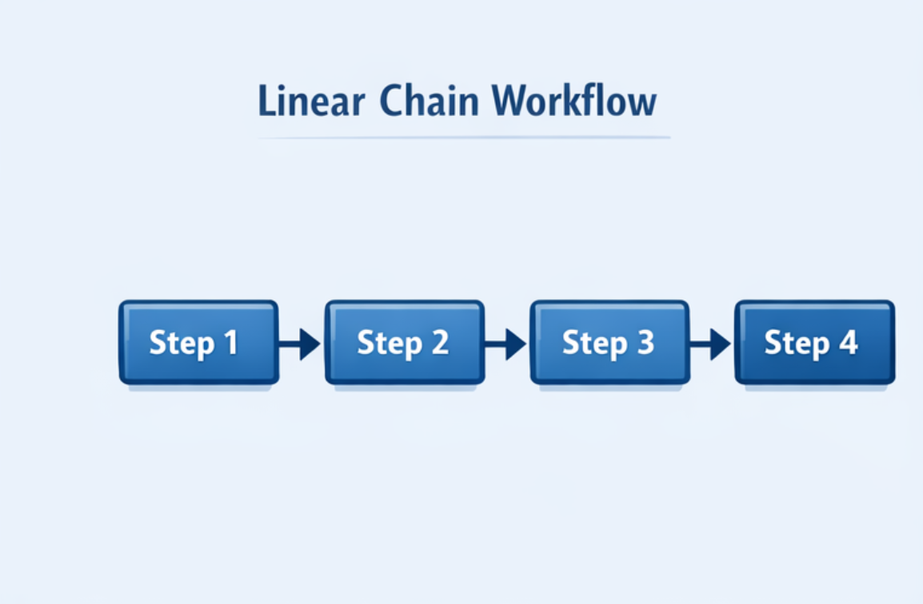
to:
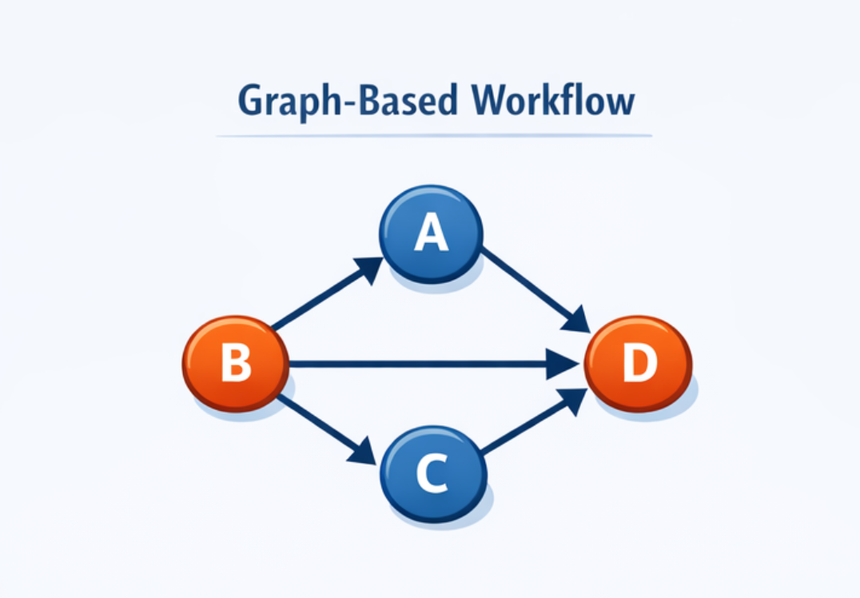
That difference matters.
Explicit State as a First Class Object
In a graph based system, state is not hidden. It is structured, versioned, and passed between nodes.
For example:
from typing import TypedDict

class AgentState(TypedDict):
    user_input: str
    retrieved_docs: list
    validation_passed: bool
    final_answer: str
Each node reads and writes to this shared state. The flow is transparent.
This reduces ambiguity and makes debugging tractable.
Graph Based Execution Patterns
Let us explore what becomes possible once orchestration is graph driven.
1. Conditional Branching
Nodes can route execution based on state:
def route_based_on_validation(state):
    if state["validation_passed"]:
        return "generate_response"
    else:
        return "retry_or_escalate"
Instead of nested Python conditionals around chains, routing becomes declarative.
2. DAG Execution
Directed acyclic graphs allow parallelizable branches.
Example pattern:
- Node A preprocesses input
- Node B retrieves documents
- Node C extracts structured variables
- Node D waits for both B and C
- Node D performs synthesis
Parallel execution reduces latency while preserving determinism.
3. Persistent Memory Nodes
Memory is modeled as a node that:
- Reads from persistent storage
- Updates conversation context
- Writes back state
This makes memory observable, testable, and replayable.
4. Deterministic + LLM Hybrid Flows
Graphs shine when combining symbolic logic and probabilistic inference.
Example hybrid pattern:
User Input
    ↓
LLM extracts structured data
    ↓
Deterministic validator
    ↓
Conditional branch
    ↓
LLM generates explanation
The deterministic validator becomes a node, not a hidden utility function.
This improves reliability in regulated or high precision workflows.
Production Debugging Advantages
One of the most underrated benefits of graph orchestration is observability.
With graph execution:
- Each node has inputs and outputs
- State transitions are inspectable
- Execution paths are traceable
- Checkpoints can be stored
If a workflow fails, we can replay from a checkpointed node instead of restarting everything.
Imagine an agent that performs:
- Retrieval
- Tool call
- Validation
- Response generation
If validation fails due to malformed tool output, we can resume at validation after fixing state.
This dramatically improves debugging cycles.
Graph definitions also make it easier to:
- Visualize workflows
- Compare execution paths across requests
- Instrument latency per node
- Introduce fine grained retry policies
Linear chains make these patterns awkward. Graphs make them native.
Failure Recovery and Checkpoints
Long running workflows introduce new failure modes:
- API timeouts
- Rate limits
- Partial tool execution
- Model output parsing failures
Graph engines allow checkpointing state at node boundaries.
This means:
- Resume without recomputing prior steps
- Inspect state before failure
- Implement exponential backoff only on affected nodes
Operationally, this aligns much better with distributed systems thinking.
A Practical Trade-off Summary
Before adopting a graph based orchestration layer, I often ask teams to evaluate five dimensions:
- Does the workflow branch based on runtime decisions
- Is state shared and mutated across multiple steps
- Do we require checkpointing or resumability
- Are deterministic validators mixed with LLM reasoning
- Do we need fine grained observability at each stage
If most answers are yes, linear chains will eventually become fragile abstractions.
Graphs are not about complexity for its own sake. They are about matching orchestration structure to workflow reality.
As agent systems grow more ambitious, the underlying orchestration model must evolve with them. Sequential chains served us well for first generation applications. But as workflows begin to look like decision networks rather than scripts, graph based execution stops being optional and starts becoming foundational.
The architecture always tells us when it is time to upgrade.